Showing posts with label number portability. Show all posts

Will MNP implementation deadline in India be deferred again

It is apprehended that the 31st Oct 2010 deadline for implementing MNP(mobile number portability) in India might be deferred again. It has already been delayed four times. Initially, MNP was to be implemented by December 31, 2009 in all the metros along with the states of Maharashtra, Gujarat, Andhra Pradesh, Karnataka and Tamil Nadu. 
The deadline was then changed to March 31, 2010 and then to June 30, 2010. The June 30 deadline was again deferred as operators were not ready with the infrastructure to provide the service. 

The latest hurdle could be US-based Telcordia Technologies which, ET reports said, could move court to protect its MNP business ambition through joint venture MNP Interconnection. The telecom department has served MNP Interconnection a show-cause notice, asking it why its licence should not be cancelled, after the Foreign Investment Promotion Board (FIPB) rejected its proposal citing security concerns. 
Besides MNP Interconnection, the other licencee is Syniverse Technologies India, which has got approvals to implement MNP in India. 

The country has been split into two number portability zones comprising 11 circles each and each zone is to be serviced by a separate MNP operator to avoid a monopoly scenario. Reports said the DoT is planning to tweak the MNP guidelines to allow a single company, Syniverse, to roll out its services nationally. I am not sure on the security issue, but it seems this will soon become the easiest way to counter business interests in India

Meanwhile, State-owned Bharat Sanchar Nigam Limited (BSNL) is said to be ready with the infrastructure to start  MNP by the scheduled Oct 31 deadline. MNP will allow users to retain their mobile telephone numbers even if they switch their operators. 

Mobile Number Portability (MNP) to kick in from 31st Dec in India

Mobile number portability (MNP) — a facility that allows customers to switch operators but retain their numbers — will kick in from December 31 across the metros and category A circles, such as Tamil Nadu and Karnataka, while the rest of the country will have access to the facility from March 31, 2010.

TRAI, the telecom regulator in India, also issued a slew of guidelines for MNP implementation. - As per the norms, once a user switches operator, he must stay for at least three months (90 days) with the new service provider before moving to another operator.
- Besides, a user holding a mobile connection is eligible to make a porting request only after three months of the date of activation of his number.
- The subscribers, who wish to port their numbers must submit their requests in writing to their service providers. The new operator must mandatorily carry out all checks, including identity verification, before completing the process, the regulator said, adding that the entire process must be completed within four days.
- Pre-paid users must give an undertaking of being aware that balances on both talktime and minutes will not be carried over to the new operator they are switching to. Post-paid customers must furnish proof that all outstanding dues to their current operator have been cleared, TRAI added.
- The operators must inform the customer about the exact date and time for the process. The regulator has also made it clear that while the operator is porting the number, the customer may have to face a ‘no service period’ that can be extended for up to a few hours during which they will not be able to receive and make calls. But in a bid to address these concerns, TRAI has said the new operator must provide the customer with a list of missed calls and messages sent during the ‘no service period’.

Syniverse Technologies and MNP Interconnection Teleco Solutions, the two companies chosen to implement it in India, had projected to regulator that less than 3% of the country’s expected 550 million-plus mobile users will go in for MNP by 2010. The regulator, when issuing MNP norms, however, did not specify the charges that customers will have to pay for switching their operator. Syniverse and MNP Interconnection had proposed to charge customers between Rs 75 and Rs 200 for porting an operator, but the regulator is yet to take a final call on the pricing issue.

Encouraging number portability results in Israel

Since we are looking forward towards introduction of number portability in India, I thought this information would be interesting - Over 600,000 Mobile Numbers Ported in Israel Since MNP Introduced.

­Over a year and a half since number portability plan was implemented in Israel, 607,000 mobile subscribers and 418,000 fixed subscribers have switched companies, reports the Ministry of Communications.

According to figures from the Mobile World, Israel ended Q1 '09 with an estimated 8.7 million mobile phone subscribers, with an additional 500,000 subscribers from the Palestinian Territories.

A case for implementing number portability in India

Well friends the debate on implementation of number portability in India is now almost 3 years old. The issue keeps popping up every time TRAI comes out with some statements. Here are the extracts of my arguments in favor of implementing the same. These were presented at a debate at IIM Bangalore. I have covered them in a post earlier , but am repeating them in view of the currency of the issue. I welcome your comments on the same. -


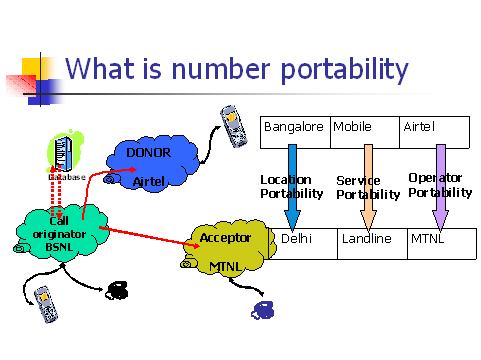
What is number portability (NP)?

Number Portability
 allows subscriber to change their service provider to one having –
 the best service quality
 lower tariff options,
 & better network coverage

while retaining their old telephone number.
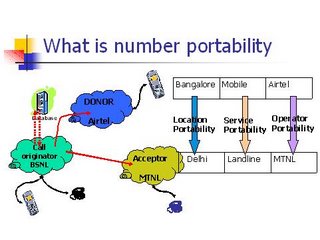


Technological reasons for implementing

Arguments against implementation - India not yet ready as Implementation requires large technological changes;

My Argument why it should be implemented
Our Mobile network is state of the art; technically much better than many countries where MNP is already working
 We introduced many services ahead of even developing countries e.g. GPRS
 Fixed line NP may have problems; can be sorted and taken up in next stage
 If it can work in S Korea – 2004; Greece – 2004; Lithuania – 2005; Belgium – 2000; Honk Kong - 1998
 why not in India


Arguments against implementation - India not yet ready as Our tele-density is still much below developed countries; We should concentrate on increasing tele-density; We have enough operators for competition

My Argument why it should be implemented
 Mobile nos. in India are largely in Urban areas. Our urban tele-density is ~40.
 We added almost 18m mobiles in last 3 months. That means urban teledensity has increased over 6 in last three months.
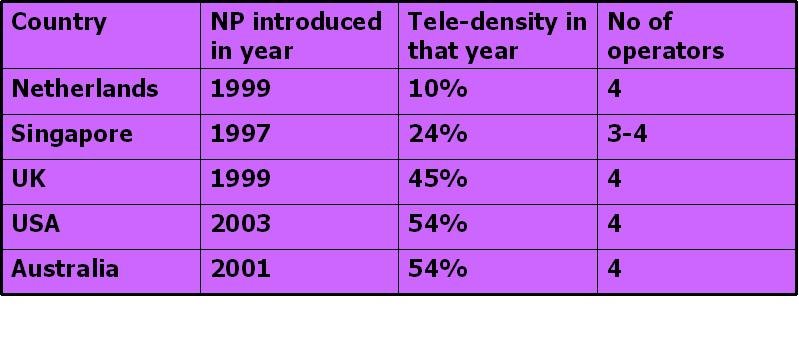
 Requires 12-18 months in implementation after decision. Urban tele-density may cross 50 by then. following table indicate that we will be at par or better than developed countries in terms of tele-density for implementing Number Portability(NP)
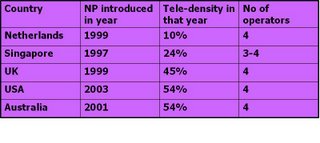


 For one service say GSM mobile we have maximum 4 operators per service area

Economic reasons

Arguments against implementation - Implementation require huge initial investments, which will outweigh the benefits. Rather we should Concentrate on improving service quality

My Argument why it should be implemented
 Its exactly the service quality for which we need NP
 Today India has one of the lowest rates for mobile services but quality of service offered is poor
 NP eliminates pseudo and psychological barriers to churning thus providing truly competitive market and service quality improvement
 Some estimate costs as high as 5000 Cr for implementation which are amplified and incorrect estimate even for implementing full fledged NP across services, operators & Locations
 Implement just Mobile NP, then go for fixed line
 Call forwarding technology does not requires much costs
 Even other technologies for mobile number portability we require central database, routing and query arrangements. It will not cost more than 150 cr to implement.
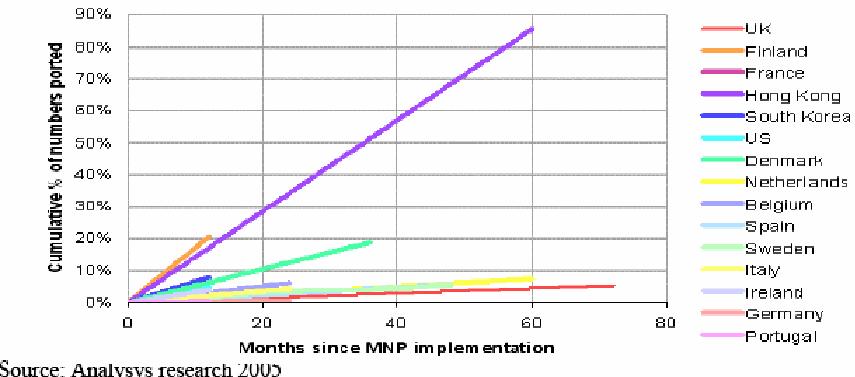
 India has 85m mobile connection now. By 2007 they will be more than 150m. Even if 10% use NP we have 15m users. (Spain 3m used.); International Data Corporation India conducted a survey and found that “30% of mobile subscribers are likely to shift to an operator offering better service, if given the option.” Internationally 10% churning of numbers with NP is common as shown in following figure-


 Charge of Just Rs 200 can cover costs. Internationally average charges are around 12-14$.
 If consumer is ready to pay for better service and availing better tariffs, why it should not be implemented

Operational reasons

Arguments against implementation - Implementation will have problems of distortions by donor networks

My Argument why it should be implemented
 Good planning and proper regulations on following issues can help in smooth operations –
 Go for all India implementation
 Don’t go for call forwarding option
 Locking of handsets to be banned
 Address lock in period problems
 Costs to be collected and born by recipient networks
 Operational problems can always be sorted out in time. After all India is not the first country to implement the NP

Conclusion
The US Supreme Court has directed adoption of number portability and India should also follow. The department of telecommunications (DoT) has set April, 2007 as the deadline for the implementation of mobile phone number portability. The deadline had been recommended by the Telecom Regulatory Authority of India (Trai) and submitted to the DoT in March '06
 India is well prepared for introducing number portability
 It should be introduced in phased manner –
 Mobile number portability across the nation amongst all operators
 Then fixed number portability
 Non implementation of NP will negate the concept of “True market” and operators will go on compromising on service quality standards

Japan's Telecom operators changing strategy in wake of MNP & Content based applications

From paying for an air ticket to buying a drink from a vending machine or watching TV on the subway, using a mobile phone is very much a part of everyday life for people in Japan.
Japan's dominant mobile phone operator is NTT DoCoMo and with 94 million handsets for a population of 127 million, Japan has the highest ratio of mobile phones to people in the world. DoCoMo has more than 55 percent of the market.
DoCoMo's I-mode (the one-touch mobile Internet service pioneered in Japan in 1999) was a great success. Getting people to use their phones as electronic wallets, as keys to the their front door, as health monitoring devices and as entertainment gadgets with a vast array of functions is the revenue-driven goal for DoCoMo and its key competitors in the mobile field, second-ranked KDDI and the upstart Softbank Mobile, the former Vodafone outlet now controlled by Internet billionaire Masayoshi Son.

The pressure is on for all three companies, following the introduction in late October of mobile number portability (MNP), allowing Japanese users for the first time to switch carriers without having to give up their existing phone number. Analysts suggest as many as 8 million users will switch and another 34 million are considering a change. But one argument put forward against a big switch is the need for customers to change their phone-based e-mail addresses, which are linked to the respective carriers.
In the marketing blitz associated with MNP in Japan, all three carriers have rushed out new handset models and new payment plans, with Softbank Mobile unveiling the most aggressive options that include waiving initial handset costs and undercutting its rivals' monthly fees.
Average revenue per user (ARPU) runs at about 6,900 yen (about $60) a month for DoComo, 6,800 yen for KDDI and about 5,600 yen for Softbank.
As the mobile commerce market is moving to the next stage of retailing, distribution and financial services the operators will require a new business model.
In the past, the focus was on increasing traffic and ARPU. But now, DoCoMo's goal -- and that of its competitors -- is to create alliances across a range of services.
One example is credit, via a mobile wallet embedded in the handset. That will require a partnership with a financial services company. Another is mobile television and music video clips, which may see the phone companies linking with broadcasters and other media providers.
Already, consumers are happy to use their phones in commercial transactions. It is common to see teenage girls on the subway, bidding for the latest cosmetics on Internet auction sites.
Another popular download service is for romance serial novels -- light fiction that can be read quickly on phone screens while commuting. And in the not-too-distant future, virtually every convenience store in Japan will offer a scanner that allows goods and services to be bought via direct debit from a phone.
Not all the new mobile services necessarily will involve competition among carriers. In disaster response mode and possibly in providing community service obligations such as remote health diagnostic services, it may be that DoCoMo, KDDI and Soffbank will work together.
Certainly, the Japanese experience is that consumers are prepared to use their phones for a variety of services, from ring tones to restaurant locations. But one key issue is the level of security surrounding their personal data. If a phone is lost or stolen, for example, how vulnerable is the information on the phone?
On the security front, it is envisaged that while handsets will offer an increasing array of functions and carry a lot of personal information, the most vital data will be protected by staying on the network's servers, rather than handsets.
Whether consumers will accept these assurances on data protection is one of the challenges ahead for carriers in the world's most upwardly mobile society.

Why number portability should be implemented in india

Well friends the debate on implementation of number portability in India is now almost 3 years old. The issue keeps popping up every time TRAI comes out with some statements. Here are the extracts of my arguments in favor of implementing the same. These were presented at a debate at IIM Bangalore. I have covered them in a post earlier , but am repeating them in view of the currency of the issue. I welcome your comments on the same. -


What is number portability (NP)?

Number Portability
 allows subscriber to change their service provider to one having –
 the best service quality
 lower tariff options,
 & better network coverage

while retaining their old telephone number.


Technological reasons for implementing

Arguments against implementation - India not yet ready as Implementation requires large technological changes;

My Argument why it should be implemented
Our Mobile network is state of the art; technically much better than many countries where MNP is already working
 We introduced many services ahead of even developing countries e.g. GPRS
 Fixed line NP may have problems; can be sorted and taken up in next stage
 If it can work in S Korea – 2004; Greece – 2004; Lithuania – 2005; Belgium – 2000; Honk Kong - 1998
 why not in India


Arguments against implementation - India not yet ready as Our tele-density is still much below developed countries; We should concentrate on increasing tele-density; We have enough operators for competition

My Argument why it should be implemented
 Mobile nos. in India are largely in Urban areas. Our urban tele-density is ~40.
 We added almost 18m mobiles in last 3 months. That means urban teledensity has increased over 6 in last three months.
 Requires 12-18 months in implementation after decision. Urban tele-density may cross 50 by then. following table indicate that we will be at par or better than developed countries in terms of tele-density for implementing Number Portability(NP)


 For one service say GSM mobile we have maximum 4 operators per service area

Economic reasons

Arguments against implementation - Implementation require huge initial investments, which will outweigh the benefits. Rather we should Concentrate on improving service quality

My Argument why it should be implemented
 Its exactly the service quality for which we need NP
 Today India has one of the lowest rates for mobile services but quality of service offered is poor
 NP eliminates pseudo and psychological barriers to churning thus providing truly competitive market and service quality improvement
 Some estimate costs as high as 5000 Cr for implementation which are amplified and incorrect estimate even for implementing full fledged NP across services, operators & Locations
 Implement just Mobile NP, then go for fixed line
 Call forwarding technology does not requires much costs
 Even other technologies for mobile number portability we require central database, routing and query arrangements. It will not cost more than 150 cr to implement.
 India has 85m mobile connection now. By 2007 they will be more than 150m. Even if 10% use NP we have 15m users. (Spain 3m used.); International Data Corporation India conducted a survey and found that “30% of mobile subscribers are likely to shift to an operator offering better service, if given the option.” Internationally 10% churning of numbers with NP is common as shown in following figure-


 Charge of Just Rs 200 can cover costs. Internationally average charges are around 12-14$.
 If consumer is ready to pay for better service and availing better tariffs, why it should not be implemented

Operational reasons

Arguments against implementation - Implementation will have problems of distortions by donor networks

My Argument why it should be implemented
 Good planning and proper regulations on following issues can help in smooth operations –
 Go for all India implementation
 Don’t go for call forwarding option
 Locking of handsets to be banned
 Address lock in period problems
 Costs to be collected and born by recipient networks
 Operational problems can always be sorted out in time. After all India is not the first country to implement the NP

Conclusion
The US Supreme Court has directed adoption of number portability and India should also follow. The department of telecommunications (DoT) has set April, 2007 as the deadline for the implementation of mobile phone number portability. The deadline had been recommended by the Telecom Regulatory Authority of India (Trai) and submitted to the DoT in March '06
 India is well prepared for introducing number portability
 It should be introduced in phased manner –
 Mobile number portability across the nation amongst all operators
 Then fixed number portability
 Non implementation of NP will negate the concept of “True market” and operators will go on compromising on service quality standards
Search your favourite topic

3G (23) 4G (10) African Telecom (3) Aircell (4) Android (4) Apple (6) Asia Pacific Telecom market (8) BSNL (10) Broadcasting (1) CDMA (10) China Telecom Market (13) DTH (1) DoCoMo (3) DoT (3) EDGE (2) EVDO (1) Enterprise Telecom Business (5) European Telecom market (9) FCC (2) GTL (1) HSPA (7) Huawei (2) IPTV (5) ITU (1) India 3G (47) India CDMA (50) India GSM (60) India Mobile (48) International Long Distance (3) Internet service providers (3) Intra Circle Roaming (1) Ipad (1) LG (2) LTE (10) M-commerce (4) MIMO (1) MTNL (3) MVNO (2) Managed networks (2) Maxis (3) Middle Eastern telecom market (6) Mobile banking (5) Motorola (3) Next Generation Networks (1) Nokia Siemens (1) OFDMA (1) QUALCOMM (1) RIM (2) Reliance Communications (16) Rural broadband (1) Russia (1) Samsung (4) Smart Pad (1) Smartphone (3) Sony Ericsson (2) South East Asian Market (3) Spectrum (9) Spice (1) Symbian (1) TD-SCDMA (2) TRAI (13) Tablet (3) Tariff (1) Tata Communications (2) Tata Teleservices (5) Telcordia (1) Tele-density (4) Telecom Market India (57) Telecom growth projections (13) Telecom regulation (7) US Telecom market (11) USO fund (4) Unique Identification Authority of India (1) VAS (2) VSNL (2) Virgin (1) VoIP (5) Vodafone (1) WAN (1) WCDMA (4) WMAN (1) WiBro (1) WiFI (13) WiMAX (20) Yota (1) ZTE (2) Zain (1) africa broadband (2) airtel (20) bharti (7) broadband (39) china mobile (37) cross media ownership (1) digital divide (3) ericsson (4) etisalat (1) fixed line market (1) fixed mobile convergence (2) forecasts for mobile market (5) idea (10) infrastructure sharing (6) largetst telecom operator (6) latest telecom news (54) mobile (21) mobile advertising (2) mobile handsets (14) nokia (7) number portability (6) rural mobile infrastructure (9) satellite communications (1) strategy for mobile operators (63) telecom equipment (22) telecom market share (17) telecom operator strategy (40) telecom policy (32) telecom sector india (31) verizon (6) vodafone india (11) wireless US (12) wireless broadband (43)