A case for implementing number portability in India

Well friends the debate on implementation of number portability in India is now almost 3 years old. The issue keeps popping up every time TRAI comes out with some statements. Here are the extracts of my arguments in favor of implementing the same. These were presented at a debate at IIM Bangalore. I have covered them in a post earlier , but am repeating them in view of the currency of the issue. I welcome your comments on the same. -


What is number portability (NP)?

Number Portability
 allows subscriber to change their service provider to one having –
 the best service quality
 lower tariff options,
 & better network coverage

while retaining their old telephone number.
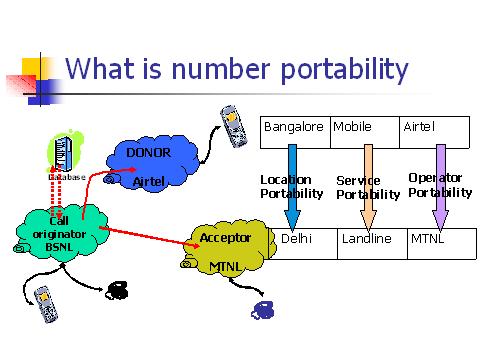


Technological reasons for implementing

Arguments against implementation - India not yet ready as Implementation requires large technological changes;

My Argument why it should be implemented
Our Mobile network is state of the art; technically much better than many countries where MNP is already working
 We introduced many services ahead of even developing countries e.g. GPRS
 Fixed line NP may have problems; can be sorted and taken up in next stage
 If it can work in S Korea – 2004; Greece – 2004; Lithuania – 2005; Belgium – 2000; Honk Kong - 1998
 why not in India


Arguments against implementation - India not yet ready as Our tele-density is still much below developed countries; We should concentrate on increasing tele-density; We have enough operators for competition

My Argument why it should be implemented
 Mobile nos. in India are largely in Urban areas. Our urban tele-density is ~40.
 We added almost 18m mobiles in last 3 months. That means urban teledensity has increased over 6 in last three months.
 Requires 12-18 months in implementation after decision. Urban tele-density may cross 50 by then. following table indicate that we will be at par or better than developed countries in terms of tele-density for implementing Number Portability(NP)
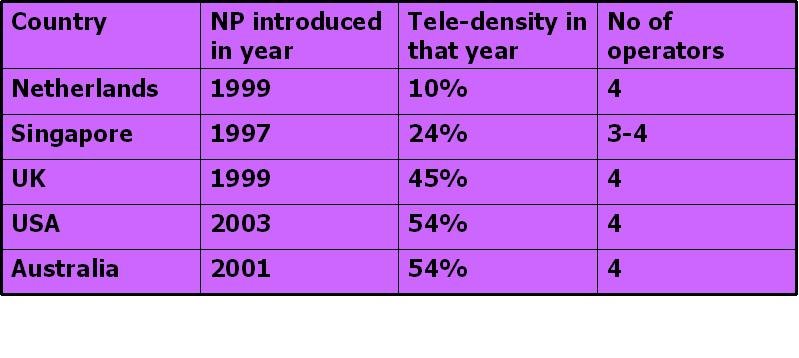


 For one service say GSM mobile we have maximum 4 operators per service area

Economic reasons

Arguments against implementation - Implementation require huge initial investments, which will outweigh the benefits. Rather we should Concentrate on improving service quality

My Argument why it should be implemented
 Its exactly the service quality for which we need NP
 Today India has one of the lowest rates for mobile services but quality of service offered is poor
 NP eliminates pseudo and psychological barriers to churning thus providing truly competitive market and service quality improvement
 Some estimate costs as high as 5000 Cr for implementation which are amplified and incorrect estimate even for implementing full fledged NP across services, operators & Locations
 Implement just Mobile NP, then go for fixed line
 Call forwarding technology does not requires much costs
 Even other technologies for mobile number portability we require central database, routing and query arrangements. It will not cost more than 150 cr to implement.
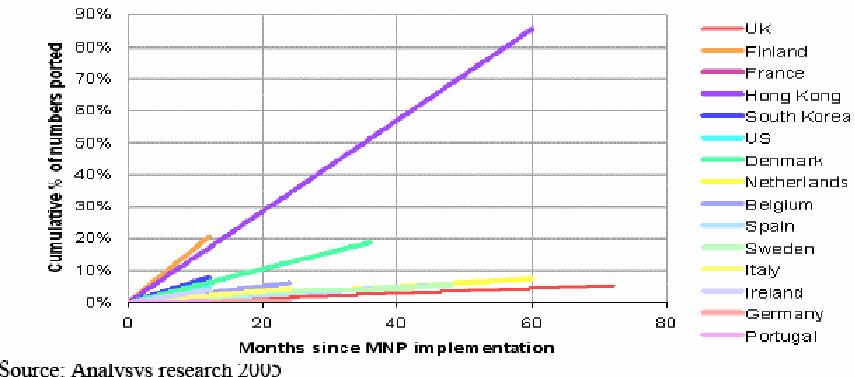
 India has 85m mobile connection now. By 2007 they will be more than 150m. Even if 10% use NP we have 15m users. (Spain 3m used.); International Data Corporation India conducted a survey and found that “30% of mobile subscribers are likely to shift to an operator offering better service, if given the option.” Internationally 10% churning of numbers with NP is common as shown in following figure-


 Charge of Just Rs 200 can cover costs. Internationally average charges are around 12-14$.
 If consumer is ready to pay for better service and availing better tariffs, why it should not be implemented

Operational reasons

Arguments against implementation - Implementation will have problems of distortions by donor networks

My Argument why it should be implemented
 Good planning and proper regulations on following issues can help in smooth operations –
 Go for all India implementation
 Don’t go for call forwarding option
 Locking of handsets to be banned
 Address lock in period problems
 Costs to be collected and born by recipient networks
 Operational problems can always be sorted out in time. After all India is not the first country to implement the NP

Conclusion
The US Supreme Court has directed adoption of number portability and India should also follow. The department of telecommunications (DoT) has set April, 2007 as the deadline for the implementation of mobile phone number portability. The deadline had been recommended by the Telecom Regulatory Authority of India (Trai) and submitted to the DoT in March '06
 India is well prepared for introducing number portability
 It should be introduced in phased manner –
 Mobile number portability across the nation amongst all operators
 Then fixed number portability
 Non implementation of NP will negate the concept of “True market” and operators will go on compromising on service quality standards

Snapshot picture of CDMA deployment in India

These extracts from report of CDMA Development Group (CDG) gives a good snapshot picture of CDMA deployment in India. I thought the extracts were worth sharing.

"The CDMA arena in India is booming, with that country's CDMA2000 subscriber base now topping 50 million fixed and mobile users. The India's subscriber growth reached this milestone in only five years, half the time it took GSM to reach the same number in the subcontinent. The CDG attributes this rapid growth in the region to the economic delivery of differentiated value-added services, network expansion into the rural areas of India and the growing availability of very-low-end (VLE) devices.

With 2 million net subscriber additions in July, CDMA2000 subscriber base in India reached 51.1 million. Reliance Communications and Tata Teleservices, which the group says are among the Top 20 fastest-growing operators in the world, are investing in the CDMA2000 business to further accelerate this growth rate. CDMA2000 devices have experienced 50 percent year-over-year growth since 2003, with more OEMs participating in CDMA than in GSM.
In addition, the rapid expansion of CDMA2000 networks into rural areas of India to deliver voice and broadband Internet access has been a primary factor in reaching the 50- million-subscriber milestone. India reportedly leads the industry in the introduction of affordable fixed and mobile broadband access to underserved markets. In fact, the CDC says Reliance has launched one of the largest CDMA2000 network expansions on the planet -- with plans to reach more than 20,000 towns and 300,000 villages. In addition, CDMA2000 operators are poised to begin a seamless upgrade of their existing networks EV-DO Rev A.
With trials underway and operators rapidly expanding into the rural areas of the country, EV-DO Rev. A is expected to become an effective platform for enabling affordable broadband Internet access and value-added services in India's rural and urban markets. BSNL has already announced tariff plans for 1X and EV-DO broadband data services, supported by PC cards and USB thumb-drive modems. Tata introduced what it says is India's first 1X USB thumb-drive modem to support its Plug2Surf wireless Internet services, while Reliance recently acquired Yipes Holdings to address the enterprise market. And recent research predicts more than 35 million people will be using mobile broadband services in India by 2010."

CDMA2000 subscriber growth is also being driven by what the CDG says is India's global leadership in the selection and availability of VLE handsets; there reportedly are 45 VLE CDMA2000 devices from 14 suppliers available in country, and that number is expected to increase dramatically with the further availability of single-chipset devices. Another 10 single-chipset VLE handsets are expected to be launched within the next month, and the Indian CDMA industry has plans to support the local production of CDMA2000 devices.

Search your favourite topic

3G (23) 4G (10) African Telecom (3) Aircell (4) Android (4) Apple (6) Asia Pacific Telecom market (8) BSNL (10) Broadcasting (1) CDMA (10) China Telecom Market (13) DTH (1) DoCoMo (3) DoT (3) EDGE (2) EVDO (1) Enterprise Telecom Business (5) European Telecom market (9) FCC (2) GTL (1) HSPA (7) Huawei (2) IPTV (5) ITU (1) India 3G (47) India CDMA (50) India GSM (60) India Mobile (48) International Long Distance (3) Internet service providers (3) Intra Circle Roaming (1) Ipad (1) LG (2) LTE (10) M-commerce (4) MIMO (1) MTNL (3) MVNO (2) Managed networks (2) Maxis (3) Middle Eastern telecom market (6) Mobile banking (5) Motorola (3) Next Generation Networks (1) Nokia Siemens (1) OFDMA (1) QUALCOMM (1) RIM (2) Reliance Communications (16) Rural broadband (1) Russia (1) Samsung (4) Smart Pad (1) Smartphone (3) Sony Ericsson (2) South East Asian Market (3) Spectrum (9) Spice (1) Symbian (1) TD-SCDMA (2) TRAI (13) Tablet (3) Tariff (1) Tata Communications (2) Tata Teleservices (5) Telcordia (1) Tele-density (4) Telecom Market India (57) Telecom growth projections (13) Telecom regulation (7) US Telecom market (11) USO fund (4) Unique Identification Authority of India (1) VAS (2) VSNL (2) Virgin (1) VoIP (5) Vodafone (1) WAN (1) WCDMA (4) WMAN (1) WiBro (1) WiFI (13) WiMAX (20) Yota (1) ZTE (2) Zain (1) africa broadband (2) airtel (20) bharti (7) broadband (39) china mobile (37) cross media ownership (1) digital divide (3) ericsson (4) etisalat (1) fixed line market (1) fixed mobile convergence (2) forecasts for mobile market (5) idea (10) infrastructure sharing (6) largetst telecom operator (6) latest telecom news (54) mobile (21) mobile advertising (2) mobile handsets (14) nokia (7) number portability (6) rural mobile infrastructure (9) satellite communications (1) strategy for mobile operators (63) telecom equipment (22) telecom market share (17) telecom operator strategy (40) telecom policy (32) telecom sector india (31) verizon (6) vodafone india (11) wireless US (12) wireless broadband (43)