Showing posts with label strategy for mobile operators. Show all posts

Indian mobile market to grow 11 percent in numbers and 8 percent in revenues in 2013


The analyst firm, Gartner, has published its new report on the Indian mobile services market. The highlights of the report are –
·     Indian mobile service market is expected to reach Rs.1.2 trillion (US$22.8 billion) in 2013, up 8 percent from 2012.
·         The mobile connections in India will grow to 770 million in 2013, an 11 percent increase from 712 million connections in 2012.
·         The mobile market in India will continue to face challenges if average revenue per unit (ARPU) does not grow significantly. India will account for 12 percent worldwide mobile connections, but just 2 percent of worldwide mobile services revenue (in constant USD) in 2013.
·    Two major challenges that India Telcos will face in near future - growing their profit margin in the face of intense competition and successfully competing with over the top service providers, such as Facebook and WhatsApp.
·      With the increased use of voice over IP (VoIP) and the probable termination of national roaming charges, mobile broadband is the area of opportunity for operators. Smaller mobile broadband plans using a sachet-style usage pattern appeal to Indian consumers.
·         Further rural expansion of mobile services will come at a cost.
·  In India, innovation in utility apps that help bring efficiencies in a consumer's life will bring in sustained revenue and will be relatively more difficult to replicate by new entrants.
·       While social and video apps are doing extremely well in India, it is time to look beyond these and deliver apps that can have a sustained business model. Operators need to insert themselves into the value chain of these new apps and services.

Design Elements of institutional framework for Spectrum trading

What is Spectrum Trading?
ITU study material on radio frequency management[[1]] explains spectrum trading as-
“In the traditional administrative approach to assignment and authorization system, spectrum is first allocated specified uses and then assigned to particular firms or public organisations that carry out the authorized use according to specific obligations as are laid down in a licence or permit. Secondary trading of spectrum, or simply ‘Spectrum Trading,’ permits the purchaser to change the use to which the spectrum was initially put while maintaining the right to use.”

Spectrum trading allows parties to transfer their spectrum rights and obligations to another party, in return for a financial or market benefit.  It allows the present user to decide when and to whom the spectrum authorization will be transferred and what sum it will receive in return.  The market, not the regulator, determines the value.  Further, a consultancy report commissioned by the European Commission, the consulting firm Analysys was cited whereby the following methods for transferring rights of use were identified -
• Sale – Ownership of the usage right is transferred to another party.
• Buy back – A usage right is sold to another party with an agreement that the seller will buy back the usage right at a fixed point in the future.
• Leasing – The usage right is transferred to another party for a defined period of time but ownership remains with the original rights holder
• Mortgage – The usage right is used as collateral for a loan, analogous to taking out a mortgage on an apartment  or a house.

Spectrum trading covers a range of possibilities, from straightforward change of ownership of an assignment with no change of use to more advanced variants in which assignments may be divided or amalgamated and use changed.[[2]]


Design Elements of institutional framework for Spectrum trading
The success of spectrum trading depends on appropriate institutional framework that precisely determines how rights of use of spectrum are transferred. In case spectrum trading is to be introduced in a country, the basic design elements that will need deliberation will be –
(a)  Definition of property rights and liability rules in terms of [[3]] :
(i)           The band which is available for use;
(ii)          The geographical area in which it can be used;
(iii)        The period for which the licence is entitled;
(iv)         The uses to which it can be put;
(v)          The licensee’s degree of protection from other users;
(vi)         The licensee’s obligation not to interfere with other spectrum user’s rights.
(b)  Flexibility or otherwise with Licensees to determine the services they want to provide with their spectrum, using the technology they deem to be the most efficient.
(c)  Transferability of property rights after trade - sale or lease, in whole or in part.
(d)  Terms and conditions of compulsory purchase backs (with compensation) if required by government under some extreme circumstances.
(e)  Need for defining or otherwise of the emission levels, interference limits
(f)   Arbitration mechanisms in case of disputes.
(g)  Mechanism of putting in place a public register [[4]] to record changes in ownership and to ensure transparency for private users, effectively displaying information on opportunities and easing entry into unoccupied bands. [[5]]


[1] http://www.ictregulationtoolkit.org/en/PracticeNote.3076.html; The ICT Regulation Toolkit is a joint production of infoDev and the International Telecommunication Union.
[2] Messolonghi, September 2002, REFARMING AND SECONDARY TRADING IN A CHANGING RADIOCOMMUNICATIONS WORLD, Electronic Communications Committee (ECC) within the European Conference of Postal and Telecommunications Administrations (CEPT)

[4] For example the Australian Communications Authority (ACA) maintains searchable register of licences to facilitate trading. - www.aca.gov.au
[5] The ability of regulators and licensees to keep track of current licences is an important component of market-based systems and can be facilitated by a publicly available database. Knowledge of the location of existing Tx’s and Rx’s (where feasible) will allow potential purchasers of rights to accurately model the existing interference environment they are seeking to enter and to enable them to properly assess the rights they seek to acquire. The database :
  • should enable regulators if called upon to adjudicate spectrum disputes and to enable them to track and assess the usage of spectrum in differing bands;
  • Should include additional tools to analyze, data on spectrum historical occupancy/usage and to interpret alternative propagation models. 

Verizon to buy spectrum leases from Clearwire as US telco's struggle to acquire airwaves rights


As per a latest news report in Wall street journal, Verizon Wireless has offered to pay as much a $1.5 billion to buy spectrum leases from Clearwire Corp. That’s about 8000 Crores in Indian Rupees. However, Verizon Wireless hasn't made an offer for spectrum that Clearwire owns. Clearwire owns some spectrum but it leases other spectrum from third parties so it can offer a nationwide network. Any bid for Clearwire spectrum could face hurdles if Sprint doesn't approve. Sprint has a number of contractual rights that pose steep obstacles for any outsider trying to do a deal.

The entire news is contrary to earlier reports according to which Clearwire had agreed to sell itself to part-owner Sprint Nextel Corp.  and Sprint agreed to sell a controlling stake in itself to Japan's Softbank Corp.

Strangely Sprint has always been looked upon as a company who would be interested in Clearwire’s spectrum. As of 2010, Clearwire was  licensed 133 MHz of spectrum, and Sprint had 51 MHz. Their combined 184 MHz represented more twice the holdings of Verizon (83 MHz) and AT&T (77 MHz), and nearly four times T-Mobile's haul (48 MHz). However, Verizon has been quietly amassing spectrum since then. Last year, the company paid $3.9 billion to acquire spectrum licenses from a group of cable companies including Comcast Corp and Time Warner Cable Inc. An access to Clearwire’s spectrum would have given Spirint an ability to compete with rivals like AT&T  and Verizon.

Clearwire's spectrum is in the 2.5 GHz (2,500 MHz) range, a band where signals don't easily penetrate walls and weaken significantly over long distances, requiring way more cell towers to transmit signal as lower-band airwaves. Verizon's spectrum in the 700 MHz band, acquired at more than $9 billion because it travels over long distances and easily passes through buildings for indoor coverage. On the positive side, the 2.5 GHz range is potentially perfect for small cells, since the higher bands can carry more data over a MHz of spectrum than lower bands, and they have less potential for interference. Some of the bigger markets like China, India and Japan are planning LTE roll outs in 2.5 GHz band. Thus the Verizon offer seems to throw open speculations that Verizon might complement it’s network in 700 MHz with small cells operating in 2.5 GHz. The U.S. telcos appear to be  evolving toward a model in which they will use the lower bands for voice and the higher bands for data transmission including video, streaming tv and cable programming.

Global mobile penetration and subscriber numbers


Verizon all set to drop unlimited data plan offer on iPhone


More and more operators are becoming allergic to Unlimited data plans on wireless. Verizon Wireless, USA based operator,  who has only just started selling the Apple iPhone,  is already planning changes to the tariff plans it offers to its customers. Specifically, it intends to cancel the headline grabbing "unlimited" mobile data tariff as soon as this summer and switch to a tiered pricing model. The mobile network operator currently offers an unlimited data option for US$30 per month, although it reserves the right to throttle the download speeds for heavy users in areas where network congestion is high. That compares to the offer from rival iPhone seller, AT&T - who charge US$25 for 2Gb of data traffic per month.

BRICI countries to have 1.2 billion Internet users by 2015 - BCG

According to a new report by the Boston Consulting Group (BCG), Internet users in BRICI countries will nearly double by 2015, hitting around 1.2 billion users. In 2009, the BRICI countries - Brazil, Russia, India, China, and Indonesia - had some 610 million Internet users.

 Although there are only 440 million PCs in the BRICI countries at present, this number should more than double by 2015 - and Internet cafés and mobile devices will also act as important means of digital access. The study says that the habits exhibited in the BRICI countries differ markedly from those in the developed markets - for instance, instant messaging is vastly more popular, as are online music and games. There are remarkable variations among the BRICI countries as well. Social networking is more popular in Indonesia and Brazil than in any of the other BRICI countries - or even in the developed markets. And while an extremely high percentage of Indian digital consumers use e-mail, Chinese Internet users have gravitated toward instant messaging.
Among the most prominent trends is that BRICI digital consumers are far more likely to be meeting their digital needs through mobile phones than through personal computers. With PC penetration still quite low, mobile phones are cheaper and more convenient tools for both communicating and seeking out entertainment - already, the BRICI countries have around 1.8 billion mobile-phone SIM card subscriptions, more than four times the combined total of those in the United States and Japan. In fact, as sophisticated handsets become available in the BRICI markets, millions of BRICI digital consumers are leapfrogging over PC usage and going online via their mobile phones, a trend that has significant implications for their Internet-usage habits.
In addition, BRICI Internet users are unusually young - more than 60 percent of digital consumers are under the age of 35 - which means that although the online habits of BRICI consumers are still being formed, these behavior patterns will have broad implications for future online activity.  

Fund raising will be the key concern for Indian Telecom service providers in 2010-11

As per Economic times - Nine cellphone companies have joined the fray for just three 3G spectrum slots while 11 companies, including Bharti Airtel, Vodafone Essar, Idea Cellular, Reliance Communications and Aircel, have bid for broadband wireless spectrum, which will allow them to provide wireless internet services.

One more interesting news was floating around. RCOM has said that it has crossed the 100-million mark in wireless customers and would explore both acquisition and expansion opportunities to strengthen its foothold in the domestic market. RCOM expects to add another 100 million customers within the next 1,000 days.

I think the time is ripe in Indian Telecom industry for consolidations. 3G auctions will be followed by M & A activity provided the auctions do not stretch the balance sheets too far. Amid ongoing price wars it would take serious efforts to raise funds for acquisitions. With interest rates moving north - the funds requirements for overseas acquisition , 3G auctions and M&A within India will be difficult to balance. The winners may emerge from those who will be able to balance fund requirements rather than balance the operations. Is Bharati listening?

Justifying tele-density in India ? Are the numbers reported by Indian Telcos inflated?

In some of my older posts, I have shown my concern on the numbers reported for users of mobile service in India. For example with entry of DoCoMo on Indian scene, the numbers Tata reported to have added last month was more than 3 million. Bharti & Vodafone continue to claim the same number of addition that they were claiming in new month. Strangely it means that with entry of new operators the existing will not loose market share. Somewhere fundamentals of economics have been defied. In other words the teledensity in India can reach 100% in ayear or so, if 10 more new operators join, as they will each add 2 to 3 million connection without decrease in the number of additions by existing operators. WoW! It seems the tele density figures in India need to be justified some how.

Recently in one of the articles published in ET,findings of a survey by online market research company JuxtConsult were reported. It says - One out of every three (57 million) urban mobile users in India now own two or more mobile connections. Believe it or not. After all this is a survey. JustConsult claims that it's the first time an estimation on the size of this segment has been attempted, as none of the industry associations––Cellular Operators Association of India (COAI) and Association of Unified Service Providers of India (AUSPI)––or sector regulator Telcom Regulatory Authority of India (Trai) have any estimation of the number of multiple connections per user.

Understanding the size, composition and motivations of this huge segment of mobile users is critical. It is needed by mobile operators in designing their marketing plans. It is also needed by handset makers and department of telecom (DoT), which is in a fix as to estimating the true teledensity of India. JuxtConsult's estimation of mobile connections in the country (till July) at 343-million is lower than TRAI's estimates of 441.6-million (August). JuxtConsult attributes the difference between its estimate and TRAI numbers to many inactive connections. Says Sanjay Tiwari of JuxtConsult: "The discrepancy is also because about 15% of reported additions by mobile operators and their associations are inflated." There are credible reasons behind operators inflating subscriber numbers. Market cap, valuation and spectrum allocation based on number of subscribers are key reasons along with the pressure to cut tariffs. It also helps attract subscribers to one's own network. A new user is likely to join a large operator as network calls come cheap.

ET also reported that the government suspected that all operators were inflating their customer figures by about 15-20% and that the DoT is planning to monitor the user base of all telecom operators to ensure that operators do not inflate subscriber numbers to grab additional spectrum. Well all this will be sorted out shortly - I hope! For the time being Justconsult deserves appreciation for trying to help in profiling the multiple user customer, whose average age largely falls between 25-35 years. According to the survey, Delhi and the national capital region account for over one in ten of all 57-million MCMU’s at 12% of the total base followed by Mumbai (8%), Bangalore (7%) and Chennai (6%). Most are actual genuine connections.

The survey, also for the first time, makes a distinction between a user and a connection, hitherto taken as one in reporting India’s teledensity and average revenue per user. As reported by ET - According to Rajat Mukherjee, chief corporate affair officer at Idea Cellular, about 20% of all telcos’ customers carry more than one SIM. The carried / thrown in dustbin SIMs remains to be distinguished

JuxtConsult’s India Mobile 2009 estimates are based on a very large sample data of around 285,000 urban and rural Indians, covering all states and union territories––574 districts, 3,175 towns and over 2,800 villages. With at least 30 plus sample each from 323 districts and 419 towns, and 100 plus sample each from 184 districts and 155 towns, the study is one of the most representative, independent enumeration of mobile phone usage in India.

With over two mobile connections per user (2.4) amongst multiple connection mobile users (MCMU), this segment account for a majority (59%) of all 235-million odd urban mobile connections. JuxtConsult’s survey did not estimate MCMU numbers for rural India. TOO MUCH TOO SOON !!

With increased urbanisation and migration from distant parts of the country to the cities, long distance calling has been on the rise across the country. ET reports that Airtel will also soon be launching a family plan where in three members of a family can buy Airtel postpaid connection but pay rental for only one. This plan is justified by the survey which shows that joint families have the highest ownership of mobile phones, with about 65% of their members owning more than one connection.

The socio economic class (SEC) A & C mobile users show higher tendency to have multiple connections, says the survey. Migrant workers and youth form a large part of the target audience. This push is also having an impact on more Mobile phone sales and launch of newer models. Sunil Dutt, country head, Samsung Mobile says he is seeing a rise in sales of Samsung’s dual mode GSM/GSM and GSM/CDMA handsets. While Nokia and Sony Ericsson don’t have such phones in the market, Spice Mobiles, has 50% of its portfolio as dual SIM phones. Such phones contribute a good 80% of the company’s revenues, says Kunal Ahooja, CEO, Spice Mobiles. The survey says that about 41% MCMUs need another spare handset for ease of use. But switching between GSM and CDMA handsets is cited as a reason by 30% buyers.

More than 500 million mobile financial services users expected by 2013 !

­The number of mobile phone subscribers that use their phones for mobile banking transactions will exceed 150m globally by 2011, according to a new study by Juniper Research. These figures refer to additive banking which is focused on developed markets rather than transformational banking. Additive banking in this context adds further choices or distribution channels for banks to serve their customers or make the banking experience more convenient for existing customers.

The Juniper Research report determined that the mobile banking market is currently most advanced in the Far East, but that growing numbers of mobile banking services are being offered in North America and Western Europe. The developed nations of the Far East, North America and Western Europe are forecast to account for over 70% of the user base by 2011.

Transactional or "push" mobile banking is being offered increasingly by banks via downloadable applications or the mobile web, complementing existing SMS messaging services for balance and simple information enquiries. Mobile banking is a key element in banks' distribution channel strategies as they compete to attract and retain customers. The Juniper report highlighted the extra user convenience as a key benefit. The mobile phone is the device that people - especially Generation Y - will not leave home without. Mobile banking is an addition to the wide choice of applications and services that they can access through their handsets to make life easier, especially via smart phones such as the iPhone.

However the report identified several factors that will need addressing to really foster market development including financial regulations which vary from country to country, application slickness, and security. Whatever the reality of the strength of the security, it is the perception and image in the mind of the user that dictates whether they will trust the service.

­Mobile technology market-watchers are always on the lookout for the next “killer app,” and according to ABI Research, mobile financial services are very likely to become the “next big thing” that will attract many millions of consumers.

“Mobile financial services have the potential to be bigger than mobile TV and premium mobile content in terms of numbers of subscribers,” says senior analyst Mark Beccue. “They have the broadest demographic appeal: almost anybody over the age of 18 is a potential user.”

Mobile financial services are of three kinds: mobile banking (essentially a mobile form of today’s online banking), mobile domestic person-to-person payments, and international person-to-person payments.

While mobile banking services are likely to find their greatest market in the industrialized world, mobile domestic and international person-to-person payments may be game-changing developments in less prosperous regions, enabling commerce, extending services to rural regions, and possibly even helping people previously excluded from the financial system to lift themselves out of poverty.

The major promoters of this market, will be banking institutions. It allows banks to increase customer ‘stickiness,’ to cut costs and automate, and most importantly, to reach the unbanked. They are scrambling for ways to do it. Moreover this market is largely recession-proof because with few exceptions it’s not about consumers spending their money, but managing it.

When it comes to mobile banking, Bank of America has been a leader. It launched its mobile banking services in May 2007 and by June of the following year already had a million mobile banking customers. Currently the service covers about 1.5 million subscribers.

Mobile tariffs to lower further in 2009?

As per reports in Economic Times, come 2009, telecom tariffs are set to fall significantly! Sector regulator TRAI on Wednesday set the ball rolling for lower tariffs by seeking the industry's views on reducing the interconnect charges (IUC).

Since IUC charges constitute a significant amount of the call charges, any reduction in this will reflect in a direct fall in tariffs. A reduction in IUC tariffs coupled with increased competition with the entry of several new players could lead to local call tariffs being as low as 10 paise per minute and STD at about 25-35 paise per minute by 2010.

Inetrconnect Usage Charges are those charges that are payable by one telecom operator to the others for use of their networks either for origination, termination or carriage of a call. Inter operator calls constitute a major part of the total calls handled by the telecommunications network. These charges are important as they can transfer network costs between operators and thus affect their relative scale and prosperity.

The current regime is as follows:

Mobile termination charge ranges from Rs 0.13 to Rs 0.30 per minute

Fixed termination charge varies from Rs 0.19 to Rs 0.28 minute

Average Carriage Charges per minute after considering the cost in respect of all NLDOs ranges from Rs 0.16 to Rs 0.72 per minute

These charges were fixed way back in 2002-03 and have not been reviewed since then, even as the overall call tariffs have by over 300% during the same time period.

The regulator will announce a reduction in IUC charges after it receives inputs from the industry.

In addition to lower tariffs, a reduction in IUC charges will also enable several of the new players who were granted telecom licences earlier this year to reduce their operational costs when they launch services. New entrants and some of the existing operators have been demanding a reduction in IUC tariffs for a long time.

Indian telecom tower industry heading for capacity surplus?

The telecom tower industry in India seems to be heading for a capacity glut. The sector will close this fiscal with over 2,50,000 towers owned by operators and stand-alone firms. With companies having aggressive tower rollout targets for years ahead, India could end up with more number of towers than required. The telecom regulator Trai has said the industry requires 3,00,000 towers by FY11.

The over-capacity situation will not only lead to longer pay-back periods for tower companies, but will also trigger consolidation in the sector. Also, tower companies will have to lower the rentals amid fierce competition, feel analysts. The announcement of merger of Quippo Telecom Infrastructure with Tata Teleservices’ tower arm alludes to significantly falling valuations in the sector. Capacity creation has risen much ahead of the aggregate minutes of usage (MoU), putting pressures on incremental margins. We are likely to see two parallel but mutually contradicting trends. With the advent of 3G services and increasing MoU in the urban markets, we are likely to see good growth in utilisation, fresh investments and rentals. But rentals and utilisation in the low population density rural markets are likely to remainunder pressure for the next 2-3 years.

Indus Towers, the joint venture between Bharti Airtel, Vodafone Essar and Idea Cellular is expected to have 95,000 towers by March this year while the figures for Bharti’s tower arm Bharti Infratel is 27,000 and for Reliance Infratel is 48,000. Besides this, Vodafone has 5,000 towers (ex-Indus), BSNL 39,000, Tata-Quippo joint venture 18,000 and GTL Infrastructure is targeting 10,000 towers by fiscal-end. This takes the total count to 2,43,000 and excludes those owned by MTNL, Idea, Aircel and tower firms like Excel and Essar Telecom Infrastructure.

As far as capacity is concerned, the sector will have more than it may require. There is going to be consolidation. Only those companies that have tenancy ratios of two and above will be profitable. In the meantime, rentals will have to take a hit.
Companies, however, have big expansion plans going forward. While Tata-Quippo is looking at a portfolio of 50,000 towers by 2012, GTL is eyeing 25,000 towers by 2011. Indus is learnt to be adding 3,000-4,0000 towers every month. By March 2010, RCOM wants to expand tower infrastructure to over 70,000 multi-tenancy towers, each capable of supporting four or more operators.

But the big question is where is the demand going to come from. While new operators like Unitech and Swan Telecom are readying to roll out operations, they will not be able to make a big difference to the demand-supply situation in the sector. Also viability of these new players remains questionable.

SMS will continue to be the cash cow of mobile data revenues

A new report from Portio Research focused on mobile messaging suggests that SMS will continue to be the cash cow of mobile data revenues for some time to come. The whole mobile messaging industry worth USD 130 billion in 2008 is predicted to be worth USD 224 billion by 2013, 60 percent of non-voice service revenues. The report, ‘Mobile Messaging Futures 2008 – 2013’ ventures that there is nothing likely to stop continued growth of mobile messaging in the short term, driven by a cocktail of ubiquitous SMS, media rich MMS, enterprise based mobile email and youth conscious mobile IM.

SMS remains ‘King’ because there is no cheap, easy to use alternative that will work with all phones and across all networks, it is loved the world over. Indeed in the US market, where SMS was a comparative slow starter, use per subscriber per month is now almost double the European average. In China average users send over 100 messages each month whereas the Filipinos continue to be the leading exponents with 755 messages each month.

Portio also predict a bright future for mobile email even though Japan is the only market where consumer mobile e-mail has surpassed the use of SMS. Email is still the most popular form of business communication and the report suggests that mobile e-mail users worldwide will quadruple from approximately a quarter of a billion users in 2008 to over a billion users by the end of 2013.

The rising star in the mobile messaging constellation is mobile instant messaging (MIM), which is still beset by the technical problems of interoperability. Portio however predict exponential growth in mobile IM users, surging from a worldwide total of 111 million users in 2008 to hit a massive 867 million users by the close of 2013. This massive growth in users will be accompanied by an equally impressive 5-fold increase in revenues from approximately USD 2.5 billion in 2008 to approximately USD 12.4 billion in 2013.

Since MMS hit the mainstream in 2004 the press and analysts have been critical about its level of success. Back then, they wanted to MMS reach the same value as SMS, USD $30bn, for it be considered a success; finally in 2009 this will be a reality. MMS is growing fast and certain countries, such as China and the United States, are becoming very big markets. Worldwide MMS traffic of 75 billion messages in 2008 is impressive, and the future growth looks very good in Asia, as affordable camera-equipped handsets flood the market with China leading the way.

More than 5 billion mobile subscribers worldwide by 2013 !

According to Informa Telecoms & Media, by 2013 the number of subscriptions worldwide will have risen to more than 5.3 billion and annual revenues from the global mobile market will top USD 1.03 trillion. From end-2007 to end-2013, the global mobile market will see huge growth, increasing in size by over half (56%), according to the latest edition of Informa Telecoms & Media’s Global Mobile Forecasts to 2013.

It took over 20 years to reach 3 billion subscriptions, but another 1.9 billion net additions are forecast in just six years, with the global total nudging past the 5-billion milestone in 2011. With this extraordinary growth, total annual revenues derived from mobile operators will grow by over a third (33.9%), jumping from USD 769 billion in 2007 to USD 1.03 trillion six years later.

Informa Telecoms & Media forecasts more than three quarters (78%) of global net additions between 2007 and 2013 to come from markets in Asia Pacific, Africa and Latin America, which will be the powerhouses of organic growth over the next five years. Astonishingly, nearly half (47%) of the 1.9 billion global net adds will come from just five markets – India, China, Indonesia, Brazil and Russia. By contrast, the mature markets of North America and Western Europe will in total contribute just 8% of global net adds, reflecting the high level of saturation in these markets.

Globally, subscription penetration will approach the 75% mark in 2013, while some countries will push past the 150% barrier – Romania (152%), Russia (153%), Italy (168%), Ukraine (173%) and Greece (183%). Growth in subscriptions (the number of SIMs) will outstrip growth in subscribers (the number of unique users), pointing to greater multi-SIM ownership. The global ratio of subscriptions to subscribers will increase from 1.29 in 2007 to 1.32 in 2013. In Western Europe, the ratio will reach 1.55 in 2013, and even higher (1.75) in Eastern Europe.

As the global subscription base expands, total annual revenues will increase to over USD 1 trillion in 2012. Voice revenues will continue to make up the lion’s share of total revenues, but will see slowing growth, and even a decline from 2010 onwards. With regulators worldwide looking to promote competition, forcing operators to push down voice tariffs, Informa Telecoms & Media expects voice revenues to peak as soon as 2009 in Western Europe, and even by end-2008 in North America. In more developing markets such as the Middle East and Asia Pacific, voice revenues will not peak until 2011, and 2012 in Latin America and the Caribbean.

Operators globally will be challenged to generate sustainable revenues as average revenue per user (ARPU) continues to drop. To keep annual revenues on the up, operators will need to promote usage of data services. Annual data revenues, unlike voice revenues, will go from strength to strength, and will more than double from USD 148 billion in 2007 to USD 347 billion in 2013. As a result, the proportion of total revenues generated by data services will increase from less than a fifth (19.2%) in 2007 to over a third (33.7%) at the end of the forecast period.

With voice revenue streams diminishing, industry players will encourage data spend among subscribers by innovating in non-voice services and differentiating their data service offerings from those of their competitors. While 2G will remain the dominant technology generation by subscription numbers until 2013, its market share will fall from over two thirds (66.9%) in 2007 to less than one third (32.7%) in 2013, as 3G+ technologies continue to gain ground. 3.5G technologies accounted for just 1.2% of total subscriptions in 2007, but will represent nearly a quarter (22.9%) of the global subscription base by 2013 and exceed the number of 3G subscriptions.

A case for implementing number portability in India

Well friends the debate on implementation of number portability in India is now almost 3 years old. The issue keeps popping up every time TRAI comes out with some statements. Here are the extracts of my arguments in favor of implementing the same. These were presented at a debate at IIM Bangalore. I have covered them in a post earlier , but am repeating them in view of the currency of the issue. I welcome your comments on the same. -


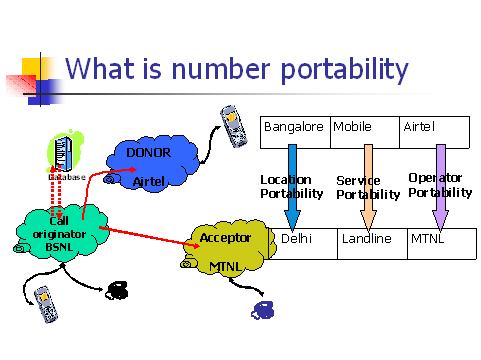
What is number portability (NP)?

Number Portability
 allows subscriber to change their service provider to one having –
 the best service quality
 lower tariff options,
 & better network coverage

while retaining their old telephone number.


Technological reasons for implementing

Arguments against implementation - India not yet ready as Implementation requires large technological changes;

My Argument why it should be implemented
Our Mobile network is state of the art; technically much better than many countries where MNP is already working
 We introduced many services ahead of even developing countries e.g. GPRS
 Fixed line NP may have problems; can be sorted and taken up in next stage
 If it can work in S Korea – 2004; Greece – 2004; Lithuania – 2005; Belgium – 2000; Honk Kong - 1998
 why not in India


Arguments against implementation - India not yet ready as Our tele-density is still much below developed countries; We should concentrate on increasing tele-density; We have enough operators for competition

My Argument why it should be implemented
 Mobile nos. in India are largely in Urban areas. Our urban tele-density is ~40.
 We added almost 18m mobiles in last 3 months. That means urban teledensity has increased over 6 in last three months.
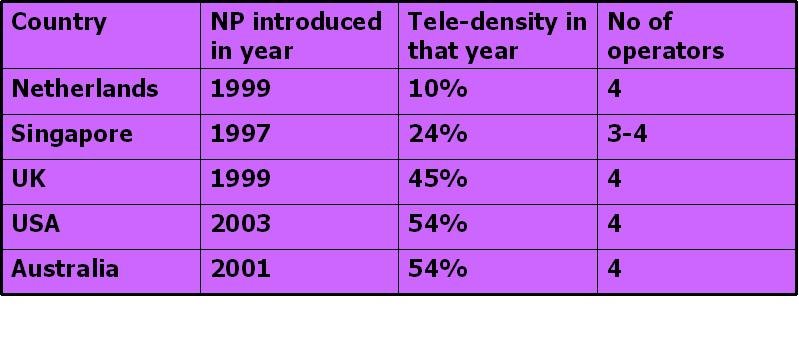
 Requires 12-18 months in implementation after decision. Urban tele-density may cross 50 by then. following table indicate that we will be at par or better than developed countries in terms of tele-density for implementing Number Portability(NP)


 For one service say GSM mobile we have maximum 4 operators per service area

Economic reasons

Arguments against implementation - Implementation require huge initial investments, which will outweigh the benefits. Rather we should Concentrate on improving service quality

My Argument why it should be implemented
 Its exactly the service quality for which we need NP
 Today India has one of the lowest rates for mobile services but quality of service offered is poor
 NP eliminates pseudo and psychological barriers to churning thus providing truly competitive market and service quality improvement
 Some estimate costs as high as 5000 Cr for implementation which are amplified and incorrect estimate even for implementing full fledged NP across services, operators & Locations
 Implement just Mobile NP, then go for fixed line
 Call forwarding technology does not requires much costs
 Even other technologies for mobile number portability we require central database, routing and query arrangements. It will not cost more than 150 cr to implement.
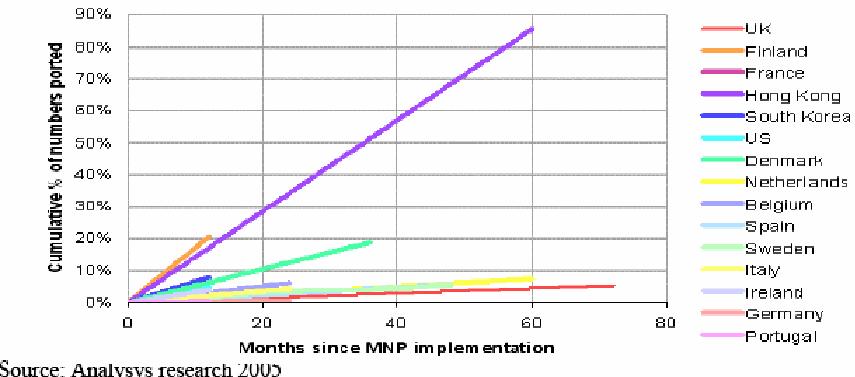
 India has 85m mobile connection now. By 2007 they will be more than 150m. Even if 10% use NP we have 15m users. (Spain 3m used.); International Data Corporation India conducted a survey and found that “30% of mobile subscribers are likely to shift to an operator offering better service, if given the option.” Internationally 10% churning of numbers with NP is common as shown in following figure-


 Charge of Just Rs 200 can cover costs. Internationally average charges are around 12-14$.
 If consumer is ready to pay for better service and availing better tariffs, why it should not be implemented

Operational reasons

Arguments against implementation - Implementation will have problems of distortions by donor networks

My Argument why it should be implemented
 Good planning and proper regulations on following issues can help in smooth operations –
 Go for all India implementation
 Don’t go for call forwarding option
 Locking of handsets to be banned
 Address lock in period problems
 Costs to be collected and born by recipient networks
 Operational problems can always be sorted out in time. After all India is not the first country to implement the NP

Conclusion
The US Supreme Court has directed adoption of number portability and India should also follow. The department of telecommunications (DoT) has set April, 2007 as the deadline for the implementation of mobile phone number portability. The deadline had been recommended by the Telecom Regulatory Authority of India (Trai) and submitted to the DoT in March '06
 India is well prepared for introducing number portability
 It should be introduced in phased manner –
 Mobile number portability across the nation amongst all operators
 Then fixed number portability
 Non implementation of NP will negate the concept of “True market” and operators will go on compromising on service quality standards

Mobile VAS revenues in India to touch Rs 8200 Cr by next fiscal !!!

According to an estimate by industry body Assocham, the mobile value added services are poised to grow by over 65 per cent to touch Rs 8,200 crore by the end of this fiscal from Rs 4,950 crore in the last fiscal . The high growth is attributed to a rapidly increasing large subscriber base and easy accessibility to the end-users. Various downloads such as ringtones, bill-related information, contest, exam results and messages received from public services such as banks, railways and airlines earn revenues for the industry. Such revenues will grow and multiply to add volumes to mobile value added services (VAS).

Indian music industry earned more than 35 million dollar from such services which is equivalent to 20 per cent of its total revenue. The total mobile music downloads in Indian markets are valued at 75 million dollars and is expected to grow by 25 per cent in the next year. SMS interactivity, which has become an integral part of most of TV shows, would become a major source of revenue for the channels. TV show Indian Idol on Sony got more than 55 million votes via SMS -- at a rate of Rs 3 per SMS, that is Rs 16.5 crore. The telecom companies earned Rs 11.5 crore and Sony made Rs 5 crore.

"Fund transfer market using mobile to grow to $8 billion by 2012" - New opportunity for Telcos

According to ABI Research, The market for mobile fund transfers will grow to a revenue opportunity of nearly $8 billion for wireless carriers by 2012, up from some $10 million last year.
By enabling subscribers to send and receive money using their wireless phones, wireless carriers have the opportunity to bring local banking services to millions of people around the world. Such services also could deliver a valuable new revenue stream. Mobile networks offer a number of advantages over existing fund transfer offerings, but most convincing is the high level of adoption and reach of wireless services both geographically and demographically. However, wireless carriers can't do this alone. The need for a banking license to offer such services in most countries means carriers must partner with established banking institutions. Partnerships are encouraged by offering services institutions an effective way to reach new as well as existing customers. ABI Research believes these partnerships, once forged between operators and the financial sector to target mobile fund transfers, also will provide a foundation for a host of additional joint offerings. Meanwhile, startups focused on delivering mobile fund transfers to mobile subscribers also have emerged to drive mobile fund transfer adoption. In one of my earlier postings - "Banks and Telcos - Partnerships of future", I have actually stressed on the same

While enabling national and even localized fund transfers delivers a good business case for operators, ABI says it is in the realm of international payments or remittances that the bulk of the market opportunity lays. Large sums already flow from workers who move overseas but send payments back to family members and friends in their home countries. Targeting these transactions, several wireless carriers and international financial institutions already are offering or developing an international capability for mobile fund transfers.

Another study by Juniper Research predicts that P2P fund transfers and mobile payments in the developing world, together with the commercialization in 2009 of NFC (Near Field Communications) based mPayments will generate transactions worth approximately $22bn and Mobile Payments to be Adopted by 204 Million Mobile Phone Users

T-mobile's new hot service - Hotspot@home

HotSpot @Home is the newest one-stop-shop offering from T-Mobile USA, combining the power of Wi-Fi and T-Mobile's nationwide voice and data network, and allowing subscribers to gab as much as they want at home without burning minutes. The carrier says its customers can use their cellphones in a VoIP manner while at home or in a T-Mobile hot-spot-enabled area, and then switch back to the GSM/GPRS/EDGE wireless network when they exit hot-spot coverage. Calls also transfer from T-Mobile's network onto Wi-Fi.
T-Mobile HotSpot @Home is a first-of-its-kind service . Key components of the T-Mobile HotSpot @Home service include new mobile phones designed to seamlessly connect the user to a home Wi-Fi connection or T-Mobile HotSpot. The Samsung t409 and the Nokia 6086 are the first to market, each retailing for $49.99 with a two-year contract on a qualifying rate plan.
T-Mobile also partnered with router manufacturers D-Link and Linksys for Wi-Fi routers optimized for a first-rate calling experience with the T-Mobile HotSpot @Home service. These select routers are designed for simple setup and enhanced battery life for the handset, and T-Mobile says they help ensure voice calls are carried "with the utmost call quality." These routers have commonly available data features found on standard routers, and they reportedly work with customers' existing broadband connection. Consumers can choose which router to use with the service; each is currently offered at no charge with the HotSpot @Home service via mail-in rebate.
For a limited time, to kick off the launch of T-Mobile HotSpot @Home, the service can be added to any qualifying T-Mobile voice plan for only $9.99 per month for a single line, and $19.99 per month for up to five lines on a FamilyTime plan. This means five family members each can have unlimited calling from home over Wi-Fi for one price, when the service is added to a qualifying FamilyTime plan.

Future growth trends in mobile industry - Greener pastures ahead !!

During last few months I have come accross several reports on future growth projections on mobile industry. Some of this data have already been posted on my blog. I thoought it was a good idea to compile some of these projections at a single place so that the readers can conviniently co-relate them. The various sources from where these projctions have been taken are also quoted below.

Mobile advertising worth $14 billion in 4yrs (2011)


Predictions and suppositions on the future evolution of mobile advertising have been going by for some time now. The latest comes from a Strategy Analytics report and says that advertisers hope on reaching more than USD14 Billion by 2011.Still, just recently, debates have emphasized the fact that mobile advertising is considered by many companies as being rather risky and less profitable than the TV alternative. This comes from the fact that the video content they use is still in a primary state and there is room for a great amount of improvement. One thing that might attract companies as to choose mobile phones for placing their advertisements is exactly the fact that this environment is yet little used. This means that it proves to be considerably easier for an announcement to stand out and be fully received by the handset users when there are no other adverts around to distract him from this specific one. The outlook for mobile advertising spend has significantly advanced in the past 12 months. The supply of advertising inventory is rapidly increasing as mobile publishers look to develop advertising as a revenue stream. Major mobile network operators like SprintNextel, Verizon Wireless and Vodafone have all accelerated plans to sell advertising within their mobile media channels and advertisers appear to be responding positively. The Strategy Analytics report also regards game downloads, mobile broadcasting and video on demand, all used as spaces for mobile advertising. Even more, several advertising companies have teamed up with mobile software and service providers in order to better develop means of reaching high profit rates.

Mobile apps worth $66 billion over 5 years


The transformation of variousenterprise applications from fixed to mobile access technology will generate more than $66 billion in carrier service revenue over the nextfive years, says a new market research report from Insight Research Corp.By the close of 2007, service revenues generated by mobile applicationstraversing wired and wireless networks in the US will reach just over $9billion; by 2012, the value of services revenue supporting thoseapplications is forecasted to grow to nearly $13 billion, according to thenew market study. Insight's newly released market analysis report, "The Mobile Workforceand Enterprise Applications 2007-2012," states that telecommunicationsindustry consolidation and job growth in the services sector are bothspeeding a transformation of various enterprise applications to a mobilityenvironment. Citing Bureau of Labor statistics, the study finds thatoccupations working outside of corporate offices are increasing at a muchfaster rate than average employment growth. At the same time, consolidationwithin the telecommunications industry has put all of the requisite pieceparts required to deliver integrated wireless applications within the handsof the remaining companies. "Analyze AT&T, Sprint, or Verizon and you will find that each companynow commands the local, metro, long-haul, and wireless assets required todeliver an end-to-end corporate solution," says Robert Rosenberg, Presidentof Insight. "Equally as important is the fact that these companies areshifting capital expenditures from infrastructure to service control,managed services, and applications. This shift in resource allocations willbenefit enterprises looking to mobilize their traditional applications, soin the months ahead we see a real rush to develop mobile applications,"Rosenberg concludes.

Mobile games worth 11.2 billion by 2010


Total global revenues from mobile games are forecast to increase from USD 2.6 billion (2005) to USD 11.2 billion by 2010, according to Mobile Games, a new strategic research report from Informa Telecoms and Media.
Downloads will account for around two-thirds of total global revenues through 2010, but online multiplayer traffic will start to generate significant income for mobile operators, as cellcos launch more multiplayer games and introduce community features that will encourage user uptake. By 2010, online multiplayer games will generate 20.5 percent of total global revenues.
"The Asia-Pacific and Europe will continue to dominate the global mobile gaming market in terms of revenues and users," says Pamela Clark-Dickson, co-author of the report, and editor of continuous research service Mobile Games Analyst, published by Informa Telecoms and Media. "However the U.S. is set to become the second largest individual market by revenues and users, behind Japan and China respectively, by 2010."
Meanwhile the mobile games industry still has work to do to encourage mass-market adoption of mobile games. This year, just 6.7 percent of all mobile subscribers globally will download and play a mobile game, rising to 15.2 percent by 2010.
"The cellcos' strategy of targeting hardcore gamers was the right thing to do when the market was in its early adopter phase," says Stuart Dredge, co-author of Mobile Games and reporter at Mobile Games Analyst. "But now what the market needs is mass-market take-up, which means that the mobile games industry has to provide games that will encourage more casual users to play."
Merger and acquisition activity is thinning out the mobile games market, especially in the games development and publishing sectors. The race is on to acquire the smaller mobile games companies whose survival to date has relied on the production and distribution of good quality games based on desirable licenses, but which haven't been able to scale their operations.
"Previously consolidation occurred mainly among mobile games companies but recent acquisitions and investments by vendors such as RealNetworks and Cisco Systems attest to a growing interest in this sector from the wider digital media and information technology industry," says Clark-Dickson.
Mobile games companies will also likely embark on brand-building and consumer marketing activities during 2005, as they launch their own direct-to-consumer offerings, and seek to build the profile of mobile gaming in the marketplace.
While the cellcos' decks will continue to be the primary source of games for mobile users, games companies have also started distributing their titles through third-party content portals and through bricks-and-mortar retailers.
"Multimedia memory cards will become an increasingly important games delivery mechanism at retail, particularly for 3D and feature-rich 2D titles," says Dredge. MMCs will contribute 9.1 percent of total global revenues for mobile games by 2010.


Mobile entertainment worth $76 billion by 2011


The mobile entertainment industry, if actualized, could reach a potential of $76 billion by the year 2011, a recent study conducted by technology market analysts Juniper Research claims. Made up of music, games, TV, and sports, the entertainment business via mobile phones has a set stage for an explosion of mobile entertainment in the coming years.

“The face of mobile entertainment is expected to change significantly over the next five years as next generation mobile services continue to be rolled out around the globe and take up steadily increases,” said Juniper Research Mobile Entertainment principal author Bruce Gibson in a company press release.

This mobile entertainment industry could reach the $76 billion mark, up from $17.3 billion in 2006. One of the main reasons for the potential boom is the current wave of third generation networks, which offer the bandwith to support mobile entertainment . Other factors include the rise of mobile video feeds and live mobile TV. Supplemented by a growing market in Asia, the mobile entertainment industry could grow along with it.

Juniper Research warns opening up a Pandora’s box for perturbed mobile users. The possibility for the monetization may be eclipsed by possible pitfalls such as gambling or pornography. These two factors alone could impinge on the successes of this untapped market.

“Whilst the potential to generate dramatically increased revenues is certainly there, many uncertainties affecting sections of the market still exist and could put a break on growth – the development of legislative environments for mobile gambling and adult content, and the success of broadcast mobile TV trails currently underway or planned, are just two examples,” said Gibson.

Mobile social networks worth $13.1 billion by 2011

Red Herring (04.16.07) reported that according to London-based Informa Telecon and Media mobile communities and user generated content (often bracketed together as social networking) will be worth $13.1 billion by 2011.

Mobile content to reach $43 billion by 2010


The global market for mobile phone premium content will exceed US$43 billion by 2010, according to a new study by iSuppli. This compares to the figure in 2004 which barely reached US$5.2 billion. Over the next four years, the market for such extra mobile services as music, gaming and video will expand at an annual rate of 42% argues the US-based research company.
According to Mark Kirstein, vice president of multimedia services and content for iSuppli, "After years of hyper growth, mobile phone markets in several major regions around the world are maturing, resulting in slower subscriber growth and declining average revenue per user for carriers. Meanwhile, new 3G networks offer increased bandwidth, but require compelling applications and content to drive revenue and provide a return on investment to operators. Against this backdrop, mobile-service carriers and content providers are establishing new business models to capture the growing opportunity."
The company believes that the main driver of premium mobile content services will be music, led by ring tones and ring tunes. iSuppli believes that this market alone was worth US$3.8 billion in 2004 and grew very quickly last year as the industry made a major transition from traditional polyphonic ring tones to ring tunes. Coming a close second in terms of growing popularity is mobile gaming, which the company believes grew by 80% in revenue terms last year. However, mobile video is seen as the best long term bet for expanding premium content services, even though the market for such services is still in its infancy.
The company argues that the success of mobile TV depends entirely on new phone deployments. According to iSuppli even with reasonably strong adoption of mobile-TV technology and subscribers, the installed base of TV-capable phones will only represent 12% of the total by 2010.

Oiling the rural connectivity - Idea Cellular uses biodiesel to fuel its BTS's power !

Indian mobile operator Idea Cellular, in an attempt to bring cellular phone service to remote areas where the electric supply is at best spotty, has begun installing mobile base stations powered by fish oil and used frying oil from local restaurants. It's believed to be the first time in the world that biofuel has powered a cell phone installation.
The oil is processed locally into biodiesel fuel and used to fuel the generators that power the base stations. So far four base stations have been installed in the Indian state of Maharashtra by Ericsson for Idea, using a grant from the GSM Association's Development Fund. The four sites were described by Ericsson as "greenfield sites that have not previously had access to a mobile network and are located in areas with unreliable power supply."

Exploring alternative power solutions, such as biofuels, is key to the development of cost-effective ways to extend mobile networks to the 20 percent of the world's population that don't have coverage today. The three companies pointed out that an important factor is that the biofuel is produced locally, creating employment in rural areas while reducing the need for transportation. Biodiesel has a much lower impact on the environment than conventional diesel, they also pointed out. The cleaner burning renewable fuel also requires fewer site visits and also extends the life of the base station generator, reducing operator costs, according to the companies.


The use of fish and cooking oil, while novel and undoubtedly an interesting recycling technique, is only temporary. Eventually the biodiesel for the cellular base stations is going to come from oil made from the seeds of the Jatropha Curcas, a tree being widely promoted worldwide as a biofuel source. That tree is said to yield four times as much biofuel as soybeans for a given size piece of land, and about half as much as highly cultivated corn. Unlike corn, though, Jathropha will grow in wastelands. India has been pushing use of Jathropha in a huge range of applications, from the biodiesel fueling the cellular base stations to use of a Jathropha extract as an anti-constipation medicine. According to an article in Wikipedia, the rail line between Mumbai and Delhi is planted with Jatropha and the train itself runs on 15-20 percent biodiesel.

Saudi Arabia's Cellular operator 'Hits' planning to create a pan-African network!

Saudi Arabia cellular carrier Hits has set up an African subsidiary funded with $1 billion and chartered to attempt to create a pan-Africa company operating across eight countries by 2012.
The new unit - Hits Africa - starts out life with a controlling stake in Liberian mobile operator Liberiacel, to soon be renamed Hits Liberia; Hits bought the Liberia property in March. The company reportedly is on the verge of receiving licenses in the Democratic Republic of Congo and Tanzania, and it says it is seeking more in at least four other countries, reportedly including Nigeria, Niger, Burundi and Ethiopia. Hits' goal is said to be to create the "first African converged player" with between 4 million and 6 million subscribers within five years.
The new African unit of Hits reportedly already has put together the team it expects to use to build its African empire. That group starts with China's Huawei, which apparently will provide the wireless network hardware. Others chosen include Devoe Team, a French company specializing in technical project management solutions; project management company MCM of Singapore; and telecom legal consultant Squire Sanders.

Search your favourite topic

3G (23) 4G (10) African Telecom (3) Aircell (4) Android (4) Apple (6) Asia Pacific Telecom market (8) BSNL (10) Broadcasting (1) CDMA (10) China Telecom Market (13) DTH (1) DoCoMo (3) DoT (3) EDGE (2) EVDO (1) Enterprise Telecom Business (5) European Telecom market (9) FCC (2) GTL (1) HSPA (7) Huawei (2) IPTV (5) ITU (1) India 3G (47) India CDMA (50) India GSM (60) India Mobile (48) International Long Distance (3) Internet service providers (3) Intra Circle Roaming (1) Ipad (1) LG (2) LTE (10) M-commerce (4) MIMO (1) MTNL (3) MVNO (2) Managed networks (2) Maxis (3) Middle Eastern telecom market (6) Mobile banking (5) Motorola (3) Next Generation Networks (1) Nokia Siemens (1) OFDMA (1) QUALCOMM (1) RIM (2) Reliance Communications (16) Rural broadband (1) Russia (1) Samsung (4) Smart Pad (1) Smartphone (3) Sony Ericsson (2) South East Asian Market (3) Spectrum (9) Spice (1) Symbian (1) TD-SCDMA (2) TRAI (13) Tablet (3) Tariff (1) Tata Communications (2) Tata Teleservices (5) Telcordia (1) Tele-density (4) Telecom Market India (57) Telecom growth projections (13) Telecom regulation (7) US Telecom market (11) USO fund (4) Unique Identification Authority of India (1) VAS (2) VSNL (2) Virgin (1) VoIP (5) Vodafone (1) WAN (1) WCDMA (4) WMAN (1) WiBro (1) WiFI (13) WiMAX (20) Yota (1) ZTE (2) Zain (1) africa broadband (2) airtel (20) bharti (7) broadband (39) china mobile (37) cross media ownership (1) digital divide (3) ericsson (4) etisalat (1) fixed line market (1) fixed mobile convergence (2) forecasts for mobile market (5) idea (10) infrastructure sharing (6) largetst telecom operator (6) latest telecom news (54) mobile (21) mobile advertising (2) mobile handsets (14) nokia (7) number portability (6) rural mobile infrastructure (9) satellite communications (1) strategy for mobile operators (63) telecom equipment (22) telecom market share (17) telecom operator strategy (40) telecom policy (32) telecom sector india (31) verizon (6) vodafone india (11) wireless US (12) wireless broadband (43)